
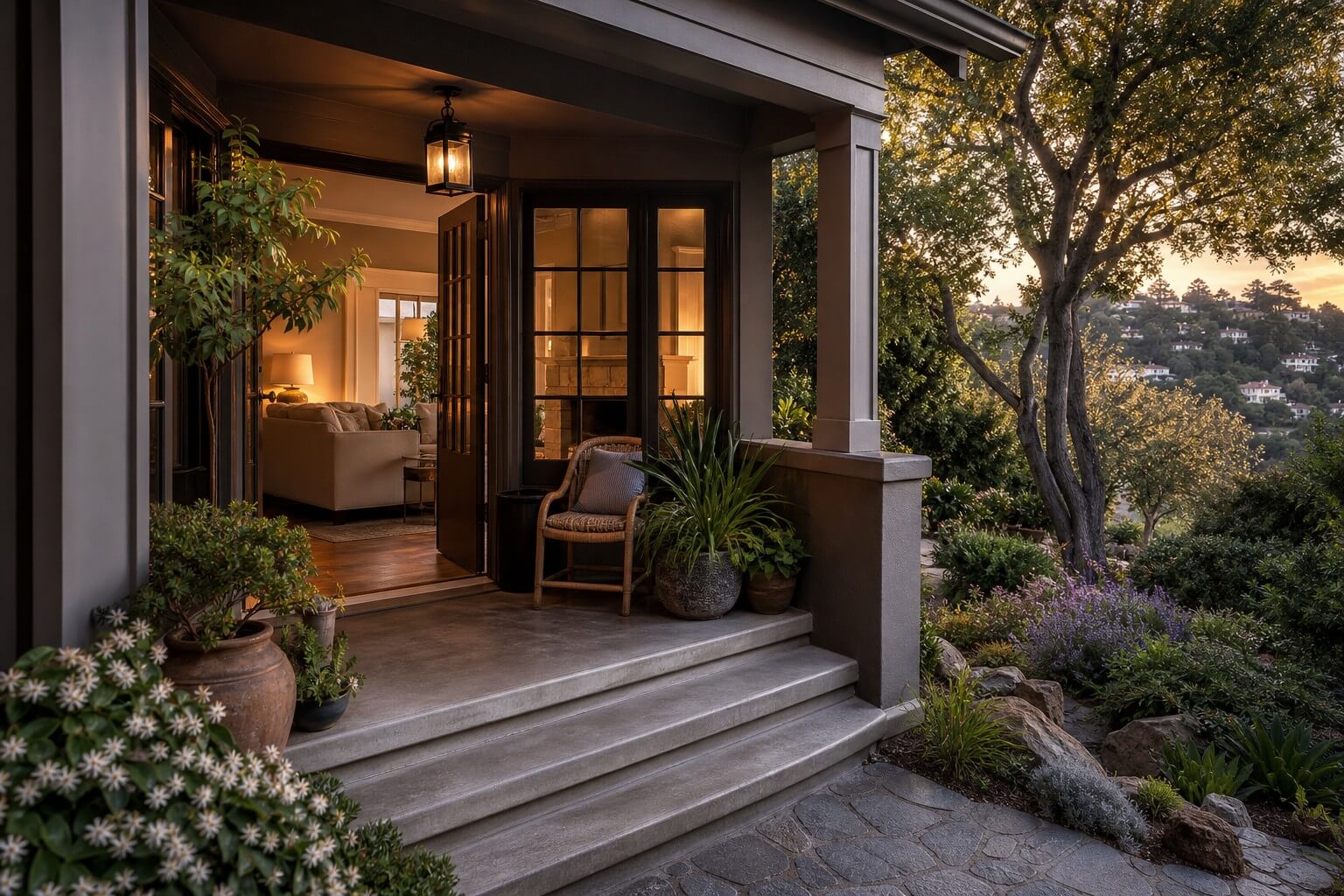
Oakland Hills vs. Walkable Oakland: Which Fits You?
Published:
Author:
Two Versions of the Same City
The Oakland Hills lifestyle and the pace of Oakland’s walkable flatland neighborhoods can feel like two different cities, even though they’re often only a few miles apart. Hills neighborhoods like Montclair, Piedmont Pines, Joaquin Miller, and Upper Rockridge offer lower density, larger lots, quiet streets, and some of the most direct access to regional parkland in the Bay Area. Flatland neighborhoods like Rockridge, Temescal, Piedmont Avenue, and Grand Lake put BART, independent restaurants, and daily errands within a short walk.
Buyers often frame the choice around price or prestige. In practice, it comes down to daily life — how you get to work, where you spend your weekends, how much you want to drive, and which trade-offs you’re willing to accept. Neither side is objectively better. One is usually a clearer fit for how a particular household actually lives.
Geography drives most of the difference. The hills rise along Oakland’s eastern edge, where neighborhoods sit against open space like Joaquin Miller Park, Redwood Regional Park, and Sibley Volcanic Regional Preserve. The flatlands spread out below on a traditional street grid, with commercial corridors along College Avenue, Telegraph Avenue, Piedmont Avenue, and Grand Avenue. That split shapes everything from commute times to insurance costs.
The Oakland Hills: Privacy, Views, and Park Access
The appeal is easy to understand after a morning in Montclair Village or a hike into Joaquin Miller Park from a nearby street. The East Bay Regional Park District manages a string of parks and preserves along the ridgeline, and in parts of Piedmont Pines, Leona Heights, and the Skyline corridor, homes back directly onto open space. Trails, redwoods, and canyon or bay views are part of the daily backdrop rather than a weekend destination.
The housing stock reflects the terrain. Most hills homes are single-family houses on larger, often sloped lots, with architecture ranging from early 20th-century cottages and midcentury designs to homes rebuilt after the 1991 Oakland Hills fire. Streets are quieter, foot traffic is light, and evenings are dark and still.
The trade-off is car dependence. According to Walk Score ratings checked in September 2026, Montclair scores 45, Upper Rockridge 47, and Leona Heights 33 — all in the “Car-Dependent” range, where most errands require a car. Montclair Village is the notable exception, a compact commercial district with a weekly farmers market, cafés, restaurants, and independent shops. For most hills addresses, though, groceries, dinner out, and BART all start with a drive or a bus ride.
Fire risk is part of the ownership equation
Wildfire exposure is the other major factor. Much of the Oakland Hills falls within a state-designated Very High Fire Hazard Severity Zone, and the Oakland Fire Department runs an annual vegetation management inspection program for hillside properties. Defensible space, ember-resistant upgrades, and insurance availability all belong in the budget conversation from the start. When standard carriers decline coverage, some owners pair a California FAIR Plan policy with a difference-in-conditions policy to fill the gaps.
For a closer look at carriers, coverage gaps, and premium strategies, see this guide to Oakland Hills fire insurance.
Walkable Oakland: Transit, Street Life, and Daily Convenience
On the other side of the equation, the flatland neighborhoods that draw walkability-focused buyers sit at the top of Walk Score’s scale. Temescal rates a 95, Piedmont Avenue a 94, and Rockridge a 90 — all “Walker’s Paradise” territory, where daily errands don’t require a car. College Avenue in Rockridge, Telegraph Avenue in Temescal, and the Lakeshore and Grand Avenue corridors around Grand Lake pack coffee shops, grocers, restaurants, and services into a few walkable blocks.
Transit is the other big advantage. Rockridge station sits on BART’s Yellow Line with direct service into San Francisco, and MacArthur station — a short walk or bike ride from Temescal — is a transfer point where three BART lines converge. For anyone commuting across the bay, walking to a station removes the bus connection or parking hunt that hills residents often build into their mornings. AC Transit fills in the gaps along the major corridors.
The housing mix is broader, too. Craftsman bungalows, brown-shingle homes, and Victorian-era houses sit alongside condos, duplexes, and mixed-use buildings. Lots are smaller, and private outdoor space usually means a backyard or patio rather than a wooded slope. Older flatland homes carry their own homework, since many predate modern seismic codes and foundation bolting, cripple-wall bracing, and aging electrical or plumbing systems come up often in inspections.
What you give up is quiet. Busier corridors bring more traffic, more competition for street parking, and more evening activity — especially near Lake Merritt, Uptown, and the main commercial strips. For many buyers, that energy is the point. For others, a year of it confirms that a yard, a view, and a quiet street matter more than they expected.
How the Two Lifestyles Compare
These are the factors that tend to decide the question once buyers start touring in both areas.
Daily Errands
Hills: A car is typically required, with Montclair Village as the main walkable node. Flatlands: Most errands are walkable or bikeable.
Commute and Transit
Hills: Drive to BART or take a bus down the hill. Flatlands: Walk or bike to Rockridge, MacArthur, or 19th Street BART.
Space and Housing Type
Hills: Mostly single-family homes on larger, often sloped lots. Flatlands: A mix of single-family homes, condos, and small multi-unit buildings on tighter lots.
Outdoor Access and Views
Hills: Direct trail access, canyon views, and bay views from many streets. Flatlands: Lake Merritt, neighborhood parks, and street-level urban views.
Noise and Activity
Hills: Quiet streets and light foot traffic. Flatlands: More traffic, street life, and evening activity near commercial corridors.
Risk and Maintenance
Hills: Wildfire exposure, vegetation management, slope and drainage. Flatlands: Lower wildfire exposure, with seismic retrofits and older systems as common inspection items.
What Stays the Same: Disclosures, Escrow, and Transfer Taxes
Buyers sometimes assume a hills purchase follows a different process than a flatland purchase. Legally, the framework is identical across the city. What changes is what shows up in the disclosures and inspection reports.
Disclosures
Under California Civil Code sections 1102–1102.18, sellers of most one-to-four-unit residential properties must provide a Transfer Disclosure Statement (TDS) documenting known material facts about the property’s condition. If the TDS is delivered after the buyer’s offer is accepted, the buyer gets a short window to terminate — three days after in-person delivery or five days after it’s mailed.
Every Oakland sale also includes a Natural Hazard Disclosure covering flood, fire, and seismic hazard zones. Hills sellers typically address slope, drainage, vegetation management, and wildfire factors, and homes in high or very high fire hazard severity zones carry additional defensible-space and fire-hardening disclosure requirements under state law. Flatland disclosures more often touch on traffic, noise, and proximity to commercial uses. Citywide, the EBMUD private sewer lateral program requires a compliance certificate when a property transfers.
Escrow and recording
Every Oakland purchase closes through escrow, typically handled by a title company’s escrow department or an independent escrow company. Ownership transfers when the grant deed records with the Alameda County Clerk-Recorder. By local custom, buyers in Alameda County usually pay escrow fees and the owner’s title policy, though every cost allocation is negotiable.
Transfer taxes
Two transfer taxes apply at recording, hills or flatlands. Alameda County’s documentary transfer tax is $1.10 per $1,000 of value. The City of Oakland’s real property transfer tax has been tiered since Measure X took effect in 2019: 1% on transfers up to $300,000, 1.5% from $300,001 to $2 million, 1.75% from $2 million to $5 million, and 2.5% above $5 million. On a $1.5 million sale, the city tax alone comes to roughly $22,500.
Oakland’s municipal code makes buyer and seller jointly and severally liable for the city tax. Local custom has the seller pay the county tax and the parties split the city tax, but the purchase contract controls, so confirm the allocation with your escrow officer before you sign.
Same process, different homework
The contract, disclosures, escrow, and taxes work the same way everywhere in Oakland. What changes is where you focus your due diligence — fire hardening, insurance quotes, and drainage in the hills; seismic work, older systems, and street conditions in the flatlands.
How to Choose Between the Hills and the Flatlands
The best decisions start with how you actually spend your time, not how you imagine you might. A few questions tend to sort it out quickly.
- How often do you commute, and where? Daily BART riders feel the difference between a walk to the station and a drive to it. Remote workers and drivers often don’t.
- What does a normal weekday evening look like? Walking to dinner and a quiet deck with a view are both good answers, but they point to different neighborhoods.
- How much risk management are you comfortable with? Hills ownership comes with ongoing vegetation work, fire-hardening upgrades, and a more involved insurance search.
- How much space do you want, indoors and out? Larger lots and more privacy generally mean moving uphill and farther from commercial corridors.
- Have you tested both? Spend a weekday commute and a full Saturday in each area before writing an offer. It’s the quickest way to see which routine fits.
For owners already living on one side of the city and weighing a move to the other, the numbers matter as much as the lifestyle. A current home valuation is a practical starting point, and the Oakland Hills 2026 Neighborhood Guide covers how individual hills neighborhoods compare.
Frequently Asked Questions
Is the Oakland Hills lifestyle quieter than living in Rockridge or Temescal?
Generally, yes. Hills neighborhoods like Montclair, Piedmont Pines, and Joaquin Miller have lower density, lighter foot traffic, and far less evening activity than College Avenue in Rockridge or Telegraph Avenue in Temescal. That quiet is a major draw for some buyers and a drawback for others who want to walk to coffee and dinner.
Which Oakland neighborhoods are the most walkable?
As of September 2026, Walk Score rates Temescal at 95, Piedmont Avenue at 94, and Rockridge at 90, all in its top “Walker’s Paradise” category. By comparison, hills neighborhoods like Montclair and Upper Rockridge score in the mid-40s, where most errands require a car.
How does commuting to San Francisco compare from the Oakland Hills and the flatlands?
Flatland residents near Rockridge, MacArthur, or 19th Street can often walk to BART, which makes door-to-door times more predictable. Hills residents usually drive to a station or take an AC Transit bus down the hill first. The difference depends on the exact address and destination, so map your specific route before deciding.
Are Oakland transfer taxes different in the hills and the flatlands?
No. Every Oakland sale pays Alameda County’s documentary transfer tax of $1.10 per $1,000 plus the city’s tiered transfer tax, which is 1.5% for sales between $300,001 and $2 million. Buyer and seller are jointly liable for the city tax, and the purchase contract sets who pays. Local custom has the seller pay the county tax and the parties split the city tax.
Do Oakland Hills sellers have different disclosure requirements?
The core requirements are the same citywide, including the Transfer Disclosure Statement, the Natural Hazard Disclosure, and EBMUD sewer lateral compliance. Homes in high or very high fire hazard severity zones, which include much of the hills, carry additional defensible-space and fire-hardening disclosures under state law.
Is home insurance harder to get in the Oakland Hills?
Often, yes. Wildfire exposure has led many standard carriers to limit new policies in hillside areas, and some owners rely on the California FAIR Plan paired with a difference-in-conditions policy. Buyers should get insurance quotes early in the contingency period rather than waiting until the end of escrow.
About Tracy Butler
Tracy Butler is an East Bay Realtor® with Vanguard Properties (DRE# 01342671 | Vanguard Properties DRE# 01486075) and has been helping clients buy and sell homes in Oakland and the surrounding communities since 2002. She specializes in the Oakland Hills — including Montclair, Piedmont Pines, Joaquin Miller, and Upper Rockridge — and brings deep local knowledge alongside a marketing background to every transaction.
Equal Housing Opportunity. This article is general information, not legal, tax, or insurance advice. Transfer tax rates, disclosure requirements, and transaction terms can change and vary by property; confirm details with your attorney, tax advisor, insurance professional, or escrow officer.